Stakeholder workshop 14 Oct 2026
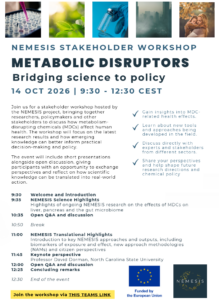
NEMESIS Stakeholder workshop: Metabolic disruptors – bridging science to policy
14 October 2026 at 9.30-12.30 Brussels time (CEST)

Join us for a stakeholder workshop hosted by the NEMESIS project, bringing together researchers, policymakers and other stakeholders to discuss how metabolism-disrupting chemicals (MDCs) affect human health. The workshop will focus on the latest research results and how emerging knowledge can better inform practical decision-making and policy.
The event will include short presentations alongside open discussion, giving participants with an opportunity to exchange perspectives and reflect on how scientific knowledge can be translated into real-world action.
Why attend?
- Gain insights into MDC-related health effects
- Learn about new tools and approaches being developed in the field
- Discuss directly with experts and stakeholders from different sectors
- Share your perspectives and help shape future research directions and chemical policy
Programme
9:30 Welcome and introduction
NEMESIS coordinator, professor Jaana Rysä, University of Eastern Finland
9:35 NEMESIS Science Highlights
Elucidating the effects of EDCs on human liver using scalable organotypic models of primary human liver cells
Senior Scientist, Dr. Oliver Burk, Robert Bosch Gesellschaft für Medizinische Forschung MBH
Endocrine disrupting chemicals: NEMESIS of the endocrine pancreas?
Professor Miriam Cnop, Université Libre de Bruxelles
Beyond the liver: the gut microbiome in metabolic responses to endocrine disruptors
Research Assistant Elmeri Mustaniemi, Karolinska Institute
10:35 Open Q&A and discussion
10:50 Break
11:00 NEMESIS Translational Highlights
Plasma 4β-hydroxycholesterol as a biomarker of exposure to xenobiotic compounds with PXR/CAR-activating properties
Professor Janne Hukkanen, University of Oulu
Smarter Science for Metabolic Health: New Approach Methodologies for Metabolism-Disrupting Chemicals
Senior researcher, Dr. Jenni Küblbeck, University of Eastern Finland
From Awareness to Action: Citizens’ Communication Needs Regarding EDC Exposure
Researcher Sofia Ribeiro, NOVA University of Lisbon
11:45 Keynote perspective
Invited speaker, professor David Dorman, North Carolina State University
12:00 Open Q&A and discussion
12:25 Concluding remarks
NEMESIS coordinator, professor Jaana Rysä, University of Eastern Finland
12:30 End of the event
Link to the online event
Download the .ics document and add the event to your calendar
Programme in pdf format

Funded by the European Union. Views and opinions expressed are however those of the author(s) only and do not necessarily reflect those of the European Union or the European Health and Digital Executive Agency (HaDEA). Neither the European Union nor the granting authority can be held responsible for them.